Monday, May 27, 2013

Tuesday, May 21, 2013
Video: The Quarter Life Crisis
I remember being in my mid-20s when this happen to me. Video description: "A video about growing up, being an adult, the anxiety that comes with adulthood, and defining your own life. This is a love letter to anyone in their 20's."
Video: The NEW Periodic Table Song
Tom Lehrer sang the original "Element Song" in 1959, which was about all the elements in the Periodic Table at the time. Since then new elements have been added, so the educators at ASAP SCIENCE updated the song. The new song covers all the elements in their correct order.
Tuesday, May 14, 2013
Video: Google Glass 2.0: What If We Had Glass?
Video description: "Now that we all have seen Google Glass we tried to think beyond version one. We wanted to visualize how heads up displays can affect our interactions with information, each other and the world. For more information check out: www.playgroundinc.com/blog/the-future-of-google-glass"
Video:3D Scanning at the Smithsonian
Video description: "What can you do to bring some of the Smithsonian's 137 million objects to life? Put them in 3D!
This is a full-time job for two of the Smithsonian's very own "laser cowboys," Vince Rossi and Adam Metallo, who work in the Smithsonian's 3D Digitization Program Office. They work hard to document, in very high three-dimensional detail, many of our priceless and important collections so that the objects are available for research, education and general interest.
Smithsonian 3D Digitization on Facebook:
http://www.facebook.com/3d.si.edu
Gunboat Philadelphia:
http://s.si.edu/kYedb
Cornell Imaging:
http://ct.biotech.cornell.edu
Smithsonian Gardens' orchid collections:
http://s.si.edu/kYhim
Euglossa ignita bee:
http://s.si.edu/kYigP"
Sunday, May 05, 2013
Video: SNL reviews Google Glass (Comedy)
Video description: "Seth welcomes tech blogger Randall Meeks, who has high praise for the Google Glass."
Monday, April 29, 2013
Video: Michio Kaku: The Universe in a Nutshell
Video Description: "The Universe in a Nutshell: The Physics of Everything Michio Kaku, Henry Semat Professor of Theoretical Physics at CUNY
What if we could find one single equation that explains every force in the universe? Dr. Michio Kaku explores how physicists may shrink the science of the Big Bang into an equation as small as Einstein's "e=mc^2." Thanks to advances in string theory, physics may allow us to escape the heat death of the universe, explore the multiverse, and unlock the secrets of existence. While firing up our imaginations about the future, Kaku also presents a succinct history of physics and makes a compelling case for why physics is the key to pretty much everything."
Saturday, April 27, 2013
Article: The Robots Are Coming, and They're Taking Jobs
Below is an excerpt from an article about how advancements in robotics (or any other new technology) slowly replace existing jobs and how to stay relevant: "It seems like every time a new technology gets created, it threatens the livelihood of individuals that derive their income from that industry. Progress destroys some jobs (generally low skilled), but at the same time it always seems to create new jobs (generally higher skilled).
Consider when the first cars came on the road, it literally killed a whole industry that was created around horses and related types of vehicles and the infrastructure needed to maintain it. For example, horse related jobs like: breeders, ranchers, stables, etc. became obsolete (or needed less) over time, but it also created thousands of new jobs that required newer skill sets, to support the car industry." (read the rest of the article)
Consider when the first cars came on the road, it literally killed a whole industry that was created around horses and related types of vehicles and the infrastructure needed to maintain it. For example, horse related jobs like: breeders, ranchers, stables, etc. became obsolete (or needed less) over time, but it also created thousands of new jobs that required newer skill sets, to support the car industry." (read the rest of the article)
Friday, April 26, 2013
Technology Evolution (videos)
I came across the top video a little while ago, then when I came across the second one it made me think of the first. I find it interesting that technology used to propel a tractor in snow 87 years ago found its way to being incorporated in to a snowboard. I wonder if the creator(s) of the second device were influence by the first.
1926 Armstead Snow Motor Vehicle
Video Description: "This screw-propelled vehicle was designed to cope with difficult snow and ice terrain. Instead of tracks, the vehicle is moved by the rotation of two horisontal cylinders fitted with a helical flange that engages with the snow surface. The Armstead Snow Motor was developed in the early 1920's. Leading Detroit automobile makers had organized a company entitled "Snow Motors Inc" to put out a machine that would negotiate the deepest snowdrifts at six to eight miles an hour. The vehicle consisted of a tractor power-plant mounted on two revolving cylinders instead of wheels."
(2013) Propul~surf
Video Description: "Propul~surf is an alternative to ski tows and snowmobiles. It is a portable device: once packed in a bag, the snowboarder (or skier) can freely go down trails.This propulsion system is based on Archimedes' screw: this is efficient and soft for the environment."
1926 Armstead Snow Motor Vehicle
Video Description: "This screw-propelled vehicle was designed to cope with difficult snow and ice terrain. Instead of tracks, the vehicle is moved by the rotation of two horisontal cylinders fitted with a helical flange that engages with the snow surface. The Armstead Snow Motor was developed in the early 1920's. Leading Detroit automobile makers had organized a company entitled "Snow Motors Inc" to put out a machine that would negotiate the deepest snowdrifts at six to eight miles an hour. The vehicle consisted of a tractor power-plant mounted on two revolving cylinders instead of wheels."
(2013) Propul~surf
Video Description: "Propul~surf is an alternative to ski tows and snowmobiles. It is a portable device: once packed in a bag, the snowboarder (or skier) can freely go down trails.This propulsion system is based on Archimedes' screw: this is efficient and soft for the environment."
Thursday, April 25, 2013
Video: The Future of Wearable Technology (PBS)
Video Description: "As computing moves from our desktops to our phones, we look into the future to see how technology will become increasingly ingrained in our movements and our active lives. From the Nike Fuelband to Google Glass, consumers are already seeing hints of the future of wearable devices. They have the possibility to make us more knowledgeable about ourselves and our surroundings, and connect us with each other in an uninterrupted, more intimate way. From DIY wearables to high-tech sensors and smart fabrics, the years ahead will show how integrated technology can impact our lives for the better."
Monday, April 08, 2013
When Everyday Technology Becomes Art
I find it interesting when technology we use everyday is considered beautiful enough to be considered art. All of this technology is from the past, and the majority of the collection is from Apple.
There are literally thousands of different pieces in Museum of Modern Art's (MOMA) complete collection.
Below is a brief list of computers and other electronics that can be found in it:
There are literally thousands of different pieces in Museum of Modern Art's (MOMA) complete collection.
Below is a brief list of computers and other electronics that can be found in it:
- ThinkPad 701c laptop
- This laptop is unique because of its foldable keyboard.
- Apple iMac computer
- This computer is unique because of its brightly colored translucent case. The popularity of this model of Macintosh literally saved apple from bankruptcy.
- Apple Macintosh 128K computer
- This was the first model of the Macintosh computer line, it also popularized the Graphical User Interface (aka GUI). The popularity of this model of Macintosh literally saved apple from bankruptcy.
- Apple G4 Cube computer
- One of Apple's more unique designs for the Macintosh line of computers.
- Grid Gridpad tablet (model 1900)
- Before the iPad or any other tablet there was the Gridpad.
- Grid Compass (model 1100) laptop
- One of the first portable computers that utilized the clam-shell design (e.g. the display folding over the keyboard) that is still used by most modern laptops.
- XO Laptop from the One Laptop per Child (OLPC)
- An early attempt to create a low-cost computer that could be used by every child in the world.
- Apple iPod media player
- This was the first model of Apple's iPod digital music player line. This device also popularized the MP3 music player.
- Apple QuickTake digital camera
- An early digital camera from Apple.
- Braun T3 pocket radio
- Dieter Rams designed this pocket transistor radio. It's believed that Jonathan Ive's original iPod design was influenced by this device.
- Sony Aibo robotic dog (ERS-110)
- An early attempt by Sony to create a domestic "Entertainment Robot".
Saturday, April 06, 2013
Video: PBS - Watch Making Stuff: Stronger (NOVA)
I have a fascination with material science and how its progressing. Our society's success and failure to generate new materials (e.g. carbon nanotubes, graphene, etc.) will determine our ability to create the next generation of structures, spacecraft, electronics, etc.
The following video PBS's NOVA, and called Making Stuff: Stronger. Here the program description from the site: "What is the strongest material in the world? Is it steel, Kevlar, carbon nanotubes, or something entirely new? NOVA kicks off the four-part series "Making Stuff" with a quest for the world's strongest substances. Host David Pogue takes a look at what defines strength, examining everything from steel cables to mollusk shells to a toucan's beak. Pogue travels from the deck of a U.S. naval aircraft carrier to a demolition derby to the country's top research labs to check in with experts who are re-engineering what nature has given us to create the next generation of strong stuff."
Sunday, March 31, 2013
Cold fusion research continues in 2013 as further experiments are planned (Wired UK)
Wired Magazine UK has posted an article on the current state of Cold Fusion (some call it LENR, then others know it as E-CAT). Whatever you want to call it, here is an excerpt from a article: "There has been steady progress in the world of Low Energy Nuclear Reactions (LENR), better known as Cold Fusion, in the last few months. The main commercial players have been quiet -- although April is likely to be make-or-break for "Energy Catalyser" (E-Cat) inventor Andrea Rossi -- but the open-source Martin Fleishmann Memorial Project (MFMP) has made some big steps towards its goal of proving the reality of LENR to a skeptical world." (read the rest of the article)
If you want more information, I have posted an article with videos and links to other sources such as: 60 Minutes and NASA on the subject. I won't say I am a supporter of the technology, I will say that I see a lot of promising information coming from sources other then from "independent scientist" I have never heard of.
If you want more information, I have posted an article with videos and links to other sources such as: 60 Minutes and NASA on the subject. I won't say I am a supporter of the technology, I will say that I see a lot of promising information coming from sources other then from "independent scientist" I have never heard of.
Friday, March 29, 2013
Video: Future Cyber-Therapist
Video description: "The USC Institute for Creative Technologies (ICT) is a leader in basic research and advanced technology development of virtual humans who think and behave like real people. ICT brings together experts in clinical psychology, cognitive science, computer vision, speech processing and artificial intelligence. This video shows two interactive technologies recently developed for multimodal perception and healthcare support" (read the entire description)
Thursday, March 21, 2013
TED Video: Elon Musk: The mind behind Tesla, SpaceX, SolarCity
Video Description: "Entrepreneur Elon Musk is a man with many plans. The founder of PayPal, Tesla Motors and SpaceX sits down with TED curator Chris Anderson to share details about his visionary projects, which include a mass-marketed electric car, a solar energy leasing company and a fully reusable rocket."
Sunday, March 17, 2013
Video: The Worlds of Viral Video (Why Videos Go Viral)
Video description: "Viral Video" is the signature phenomenon of internet media. Something akin to pop songs, these videos with irresistible hooks have saturated video culture online and have now evolved into a multitude of sophisticated forms. Whether rooted in comedy, spectacle, schadenfreude, cuteness, politics, performance, or deep meaning, the idea of viral videos, and the huge audiences they generate, have forever changed the values and potential impact of video online."
Did we go from the being the MTV generation to the YouTube generation?
Thursday, March 14, 2013
Video: Stewart Brand: The dawn of de-extinction.
Video description: "Throughout humankind's history, we've driven species after species extinct: the passenger pigeon, the Eastern mountain lion, the dodo .... But now, says Stewart Brand, we have the technology (and the biology) to bring back species that humanity wiped out. So -- should we? Which ones? He asks a big question whose answer is closer than you may think."
Video: Michio Kaku: Can Nanotechnology Create Utopia?
Video description: "Dr. Kaku addresses the question of the possibility of utopia, the perfect society that people have tried to create throughout history. These dreams have not been realized because we have scarcity. However, now we have nanotechnology, and with nanotechnology, perhaps, says Dr. Michio Kaku, maybe in 100 years, we'll have something called the replicator, which will create enormous abundance. "
Video: Amazing Water & Sound Experiment
Excerpt from video description: "The effect that you are seeing can't be seen with the naked eye. The effect only works through the camera. However, there is a version of the project you can do where the effect would be visible with the naked eye. For that project, you'd have to use a strobe light." (more information see the video page)
Monday, March 04, 2013
Allan Savory: How to green the world's deserts and reverse climate change
Video Description: "'Desertification is a fancy word for land that is turning to desert,' begins Allan Savory in this quietly powerful talk. And terrifyingly, it's happening to about two-thirds of the world’s grasslands, accelerating climate change and causing traditional grazing societies to descend into social chaos. Savory has devoted his life to stopping it. He now believes -- and his work so far shows -- that a surprising factor can protect grasslands and even reclaim degraded land that was once desert."
Thursday, February 28, 2013
Will 3D Printing Change the World?
Video description: "Much attention has been paid to 3D Printing lately, with new companies developing cheaper and more efficient consumer models that have wowed the tech community. They herald 3D Printing as a revolutionary and disruptive technology, but how will these printers truly affect our society? Beyond an initial novelty, 3D Printing could have a game-changing impact on consumer culture, copyright and patent law, and even the very concept of scarcity on which our economy is based. From at-home repairs to new businesses, from medical to ecological developments, 3D Printing has an undeniably wide range of possibilities which could profoundly change our world."
Wednesday, February 27, 2013
Video: Sugata Mitra: Build a School in the Cloud
Video description: "Onstage at TED2013, Sugata Mitra makes his bold TED Prize wish: Help me design the School in the Cloud, a learning lab in India, where children can explore and learn from each other -- using resources and mentoring from the cloud. Hear his inspiring vision for Self Organized Learning Environments (SOLE), and learn more at tedprize.org. "
Video: The Super Supercapacitor (Next Generation Battery Technology)
Video Description: "Ric Kaner set out to find a new way to make graphene, the thinnest and strongest material on earth. What he found was a new way to power the world."
Monday, February 25, 2013
Video: Solve for X: Charles Chase on energy for everyone
Video Description: "Solution: A 100MW compact fusion reactor that runs on plentiful and cheap deuterium and tritium (isotopes of hydrogen). Breakthrough technology: Charles Chase and his team at Lockheed have developed a high beta configuration, which allows a compact reactor design and speedier development timeline (5 years instead of 30)."
Thursday, February 21, 2013
Video Description from SlashDot: "Many of us have plug-in external batteries of one sort to recharge our smart phones when we're away from power outlets. Or we have gigantic aftermarket batteries that make our phones so fat they barely fit in our pockets. So there is this company, Lilliputian Power Systems, that is just starting to market a tiny, butane-powered fuel cell they call the Nectar that plugs into your cell phone (or whatever) through a USB port and supposedly charges it for up to two weeks. That's a lot better than an add-on battery. It looks expensive, although the power "pods" aren't too pricey at $19.99 for two."
Esther Perel: The secret to desire in a long-term relationship
Video Description: "In long-term relationships, we often expect our beloved to be both best friend and erotic partner. But as Esther Perel argues, good and committed sex draws on two conflicting needs: our need for security and our need for surprise. So how do you sustain desire? With wit and eloquence, Perel lets us in on the mystery of erotic intelligence."
Lee Cronin: Print your own medicine
Video Description: "Chemist Lee Cronin is working on a 3D printer that, instead of objects, is able to print molecules. An exciting potential long-term application: printing your own medicine using chemical inks."
Tuesday, February 05, 2013
Monday, February 04, 2013
Michio Kaku: Faster than light speed is possible
Howard White, a professor working at NASA made some tweaks to the shape of the bubble allowing this process to take place with the amount of energy required to deliver a modern rocket to space. (article)
Sunday, February 03, 2013
Cameron Herold: Let's raise kids to be entrepreneurs
Video Description: "Bored in school, failing classes, at odds with peers: This child might be an entrepreneur, says Cameron Herold. In his talk, he makes the case for parenting and education that helps would-be entrepreneurs flourish -- as kids and as adults."
Wednesday, January 30, 2013
Video: Voice Over (English Subtitles)
This is a great video about an astronaut struggling to stay alive after crash landing on an unknown planet. As his air supply dwindles, he starts contemplating his current situation and how it compares to other life and death scenarios. I don't want to give away too much, but I will say its very well done.
Video: Wingham Rowan: A new kind of job market
Description: Plenty of people need jobs with very flexible hours -- but it's difficult for those people to connect with the employers who need them. Wingham Rowan is working on that. He explains how the same technology that powers modern financial markets can help employers book workers for slivers of time.
Monday, January 21, 2013
Thursday, January 17, 2013
Dr. Wade Adams: Nanotechnology and the Future of Energy
Video Description: "Dr. Wade Adams, Associate Dean of the School of Engineering at Rice University, passionately explains what nanotechnology is and why it is fundamental to solving many of the world's most pressing challenges." Nanotechnology may one day do everything from curing cancer to solving the world's energy problems.
Tuesday, January 15, 2013
Video: Jane McGonigal: How Gaming Will Change the World
Video Description: "Jane McGonigal, author of The New York Times best seller "Reality Is Broken" and world-renowned designer of alternate reality games, talks about how games can be created to improve the way we learn, work, solve problems, and lead our real lives."
Web site: National Flu Situation Page 2013
Want the latest information (such as CDC maps, news and twitter feeds and more) on the current national flu situation, check out the following page on the VueToo site.
Video: Ellen Jorgensen: Biohacking -- you can do it, too (The rise of DIYbio labs)
Video description: "We have personal computing, why not personal biotech? That’s the question biologist Ellen Jorgensen and her colleagues asked themselves before opening Genspace, a nonprofit DIYbio lab in Brooklyn devoted to citizen science, where amateurs can go and tinker with biotechnology. Far from being a sinister Frankenstein's lab (as some imagined it), Genspace offers a long list of fun, creative and practical uses for DIYbio."
Saturday, January 12, 2013
Arictle: White House shoots down petition to build Death Star
Excerpt from CNET article: "However, in a playful, "Star Wars"-inspired response titled "This Isn't the Petition Response You're Looking For," Paul Shawcross, the chief of the science and space branch at the White House Office of Management and Budget, explains that construction of the universe's ultimate weapon would cost $850 quadrillion ($850,000,000,000,000,000). The administration also said it was reluctant to spend such an uncountable amount on "a Death Star with a fundamental flaw that can be exploited by a one-man starship."" (read the rest of the article)
Sunday, January 06, 2013
Video: 53 Terrible Jokes! (That you will like, but won't admit)
Okay most people will like a few of these jokes, but most are pretty bad but they're clean. ;-)
Friday, January 04, 2013
Video: Futuristic highways in the Netherlands glow in the dark
Here are some innovative ideas for the highway. The only issue will be will some of them be more of a driver distraction then helpful. Then there are other issues like how do you pay for the energy used to power the electronic car induction lanes, or to pay for the other enhancements.
Video description: "A futuristic highway that can save energy and improve road safety is set to be installed in the Netherlands by mid-2013. Two companies, Studio Roosegaarde and Heijmans Infrastructure, came up with the highway, which includes: glow-in-the-dark road markings painted with photo-luminescent paint which are charged during the day and light up during the night; temperature-responsive paint which indicates slippery roads when temperatures fall below zero; and interactive lights along the highway that light up as cars approach. Wind lights that light up using the draft produced by cars and priority induction lanes that can recharge electric cars as they run along them also feature.
The luminous road markings and weather indicating roads will debut in the Dutch province of Brabant in the middle of next year. The wind powered and interactive lights along with the induction lanes are also planned to go into service in the next years."
Wednesday, December 26, 2012
Video: Why Being Unreasonable Jumpstarts Social Innovation
Video Description (from Social Innovation Summit on FORA.tv): "Daniel Epstein, founder of the Unreasonable Institute, explains why being unreasonable jumpstarts social innovation. "
Friday, December 14, 2012
Andrew McAfee: Are droids taking our jobs?
Video Description: "Robots and algorithms are getting good at jobs like building cars, writing articles, translating -- jobs that once required a human. So what will we humans do for work? Andrew McAfee walks through recent labor data to say: We ain't seen nothing yet. But then he steps back to look at big history, and comes up with a surprising and even thrilling view of what comes next. (Filmed at TEDxBoston.)" (source)
Video: Reinventing Fire: Bold Solutions for the New Energy Era (Fora)
Summary: "Amory B. Lovins and Edward Lucas discuss how bold solutions for the new energy era is akin to reinventing the fire.Dr. Amory B. Lovins, Co-founder, Chairman and Chief Scientist, Rocky Mountain Institute" (more information)
Thursday, December 06, 2012
Transforming Apartment: Living With Less as More (Video)
For the last few years I have seen multiple online videos where designers are exploring customized movable "funiture-walls". These movable wall have built-in furniture and other spaces such as closets and places for different appliances like TVs, computers, etc. to fully utilize small areas (for example, 400 sq ft and less). It gets you wondering if this could be the future of apartment design? I am also wondering if it will create a fads like "less is more hip then big" or "my apartment generates less carbon then yours".
I have to personally admit I am a fan of this trend, and I would live in one of these apartments if they were available. I like the idea of being able to transform the apartment as needed. For example, if you have guests that are staying over, you move a wall and pull out of full-size foldable bed. Or you could hide the master bedroom by moving another wall, and open up a living room area for working, eating, entertaining or relaxing.
I am not big on having a lot of space that I don't use, have to clean and heat. Personally I believe if I don't use something, then I should get rid of it (although I have to admit I am still working on practicing what I preach when I say this).
Excerpt from video description: "barcode room is a concept studio apartment composed of product furniture-walls which move freely from side to side, permitting the resident to customize the size of space to fit a variety of uses. Placing functional elements such as storage and furniture into these walls, only to be pulled out when in use, also allows for more of the floor area to be used by the inhabitant and guests, thus creating a space where one is able to both comfortably live and entertain a different number of guests easily." (read the rest of the article)
I have to personally admit I am a fan of this trend, and I would live in one of these apartments if they were available. I like the idea of being able to transform the apartment as needed. For example, if you have guests that are staying over, you move a wall and pull out of full-size foldable bed. Or you could hide the master bedroom by moving another wall, and open up a living room area for working, eating, entertaining or relaxing.
I am not big on having a lot of space that I don't use, have to clean and heat. Personally I believe if I don't use something, then I should get rid of it (although I have to admit I am still working on practicing what I preach when I say this).
Excerpt from video description: "barcode room is a concept studio apartment composed of product furniture-walls which move freely from side to side, permitting the resident to customize the size of space to fit a variety of uses. Placing functional elements such as storage and furniture into these walls, only to be pulled out when in use, also allows for more of the floor area to be used by the inhabitant and guests, thus creating a space where one is able to both comfortably live and entertain a different number of guests easily." (read the rest of the article)
Saturday, December 01, 2012
Billion Dollar Idea: Build a Better Battery
Billion Dollar Idea: Build a Better Battery
There is a paraphrased quote attributed to Ralph Waldo Emerson from the late nineteenth century "build a better mousetrap, and the world will beat a path to your door". An updated version of that quote should read, "build a better battery, and the world will beat a path to your door"
I have said if anyone wants to be a quick billionaire, all they have to do is invent a revolutionary battery that has a high power density, that is small, light weight and inexpensive to build. The problem is like most things, "it's a lot easier said then done".
One of the biggest technological hindrances to current and futures technologies (from smartphones, to cars, to power grids, etc.) is the current state of battery advancements If you look at the rate of advancements in other technologies, you can see exponential growth that has been happening for years and even decades. For example, if you look at Moore's Law you will see a logarithmic advance in the density of transistors in CPUs over the decades.

The current state of modern batteries has progressed very slowly over the centuries and even last few decades. For example:
Over the last few years, some manufactures have been working on alternative technologies to replace or supplement conventional batteries such as supercapacitors, and direct methanol fuel cells. There have been experimental advancements in battery materials like lithum-air, and carbon nanotube electrodes. As of 2012 Lithium iron phosphate (LiFePO4) batteries were the fastest-charging and discharging batteries.
Per a recent article that I saw, it had the title: "DOE wants 5X battery power boost in 5 years". Here is an excerpt from the article "The DOE is creating a new Joint Center for Energy Storage Research, at a cost of $120 million over five years, that's intended to reproduce development environments that were successfully used by Bell Laboratories in the World War II Manhattan Project that produced an atomic bomb. "
As far as grid level storage there are liquid metal batteries from a company called Ambri. For more information watch the video below from TED, where Donald Sadoway gives a talked called "Liquid Metal Battery - The Missing Link to Renewable Energy"
There is a paraphrased quote attributed to Ralph Waldo Emerson from the late nineteenth century "build a better mousetrap, and the world will beat a path to your door". An updated version of that quote should read, "build a better battery, and the world will beat a path to your door"
I have said if anyone wants to be a quick billionaire, all they have to do is invent a revolutionary battery that has a high power density, that is small, light weight and inexpensive to build. The problem is like most things, "it's a lot easier said then done".
One of the biggest technological hindrances to current and futures technologies (from smartphones, to cars, to power grids, etc.) is the current state of battery advancements If you look at the rate of advancements in other technologies, you can see exponential growth that has been happening for years and even decades. For example, if you look at Moore's Law you will see a logarithmic advance in the density of transistors in CPUs over the decades.
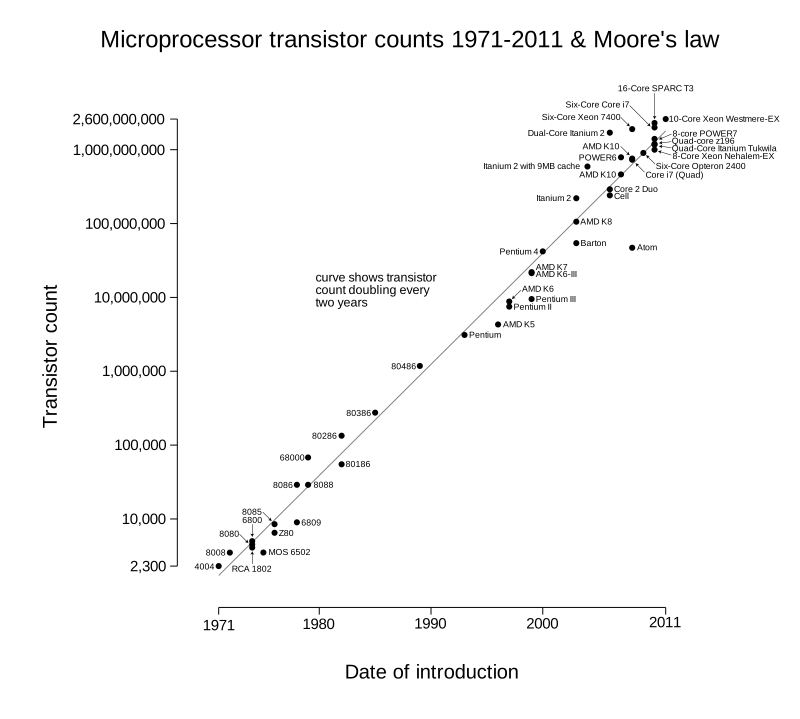
from: Wikipedia
The current state of modern batteries has progressed very slowly over the centuries and even last few decades. For example:
- The first electrochemical cell was developed by the Italian physicist Alessandro Volta in 1792, and in 1800 he invented the first battery, a "pile" of many cells in series.
- The Daniell cell in 1836, batteries provided more reliable currents and were adopted by industry for use in stationary devices, in particular in telegraph networks where they were the only practical source of electricity.
- Near the end of the nineteenth century, the invention of dry cell batteries, which replaced the liquid electrolyte with a paste, made portable electrical devices practical.
Over the last few years, some manufactures have been working on alternative technologies to replace or supplement conventional batteries such as supercapacitors, and direct methanol fuel cells. There have been experimental advancements in battery materials like lithum-air, and carbon nanotube electrodes. As of 2012 Lithium iron phosphate (LiFePO4) batteries were the fastest-charging and discharging batteries.
Per a recent article that I saw, it had the title: "DOE wants 5X battery power boost in 5 years". Here is an excerpt from the article "The DOE is creating a new Joint Center for Energy Storage Research, at a cost of $120 million over five years, that's intended to reproduce development environments that were successfully used by Bell Laboratories in the World War II Manhattan Project that produced an atomic bomb. "
As far as grid level storage there are liquid metal batteries from a company called Ambri. For more information watch the video below from TED, where Donald Sadoway gives a talked called "Liquid Metal Battery - The Missing Link to Renewable Energy"
Article: How to Clean Up Your Online Presence and Make a Great First Impression
Depending on how much of your personal information you share on the Internet, such as postings on Facebook, Twitter, or any of the billion other social networking sites that are out there. You might have left a "online presence" (e.g. comments, pictures, etc.) that might not best represent who you really are.
If you're current or future employer, significant other to does a quick check of Google, Bing, Facebook, Twitter, etc. What will they find?
There are somethings (such as, public record, postings, etc.) on the Internet that are not easy to get removed, while there are other things you can (such as, deleted cached web page information).

LifeHacker has a great article on "How to Clean Up Your Online Presence and Make a Great First Impression", here is excerpt from it: "Odds are someone is searching the web for you right now, or at least has looked you up fairly recently. Do you know what they learned? Better yet, do you control the pages and profiles they visited? If not, it's time to take your online reputation into your own hands instead of leaving it to Google. Here's how." (read the rest of the article)
If you're current or future employer, significant other to does a quick check of Google, Bing, Facebook, Twitter, etc. What will they find?
There are somethings (such as, public record, postings, etc.) on the Internet that are not easy to get removed, while there are other things you can (such as, deleted cached web page information).

LifeHacker has a great article on "How to Clean Up Your Online Presence and Make a Great First Impression", here is excerpt from it: "Odds are someone is searching the web for you right now, or at least has looked you up fairly recently. Do you know what they learned? Better yet, do you control the pages and profiles they visited? If not, it's time to take your online reputation into your own hands instead of leaving it to Google. Here's how." (read the rest of the article)
Article: How GE radically transformed their IT deployment (Great Read)
If you're a project manager, I would highly-recommend this article. TechRepublic wrote a great article about how GE transformed their IT deployment. Here is excerpt: "How GE Appliances overcame that obstacle — or, more accurately, is still in the process of overcoming it — says a lot about where GE is going as a company and how today’s enterprise IT departments are having to make radical changes in order to adapt to the relentless pace of a faster, leaner, and more global business environment. Inside GE, this initiative has been dubbed “ERP ” and TechRepublic interviewed executives, IT leaders, and key employees at GE Appliance Park to get the story on how they are pulling it off."
Article: Netflix Alternatives (Streaming Movie Sites)
Below is a excerpt from an article on a web site called The Jason Chronicles called "Netflix Alternatives (Streaming Movie Sites)": "Like many people, I have ditched my TV several years ago and get most of my video entertainment from sites like Hulu and Netflix. I have been a huge fan of Netflix for years, I thought they provided a great deal for what you got. Although, after their rate hikes in 2011, I have been contemplating alternatives to their service.
It is worth noting that most of these services are not subscription based like Netflix, they're fee based so you pay for every movie you watch. This is great for people who only watch movies once in a while, but if you like to watch a lot of streaming movies or TV shows this can get expensive.
The service offerings of these websites change all the time by adding new features, services and prices so the list of providers below are only pointers." (read the rest of the article)
It is worth noting that most of these services are not subscription based like Netflix, they're fee based so you pay for every movie you watch. This is great for people who only watch movies once in a while, but if you like to watch a lot of streaming movies or TV shows this can get expensive.
The service offerings of these websites change all the time by adding new features, services and prices so the list of providers below are only pointers." (read the rest of the article)
Sunday, November 25, 2012
Video: The Amazing Transformation of a Guy Who Didn't Give Up!
This is a pretty inspirational video, it reminds you that even when the world tells you "its impossible", you don't always have to listen.
The Importance of Good IT Implementation (Wining and Losing)
Obama utilized technology to help him win both elections. In the 2008 election, he leveraged "social media". In the 2012 election he used "big data".
The 2012 election was also the most expensive ever run. It was estimated that $6 billion was spent nationwide, according to the Center for Responsive Politics, a nonprofit group that tracks campaign finances. (Here is some more information.)
Like anything, when "data" is used properly it can help any organization, and if not properly utilized it won't I think these articles below help demonstrate the importance of a "well organized" I.T. group.
I think it all comes down to good upfront planning/gathering requirements, systems design, implementation/deployment, and hard work (I am over simplifying the whole process, but it covers the basics). If you're in I.T. other considerations are maintenance/monitoring, disaster recovery (we need to remember that "stuff happens" like Sandy, Katrina, earthquakes, etc.), end of life (e.g. project completion).
How Obama did it: On Nov. 17, 2012, on the Business Insider website, they published the following article: "40 Engineers Worked 14-Hour Days, 7 Days A Week To Get Obama Reelected—Here Is Their Story". Below is a excerpt form the article: "The Obama campaign's technologists were tense and tired. It was game day and everything was going wrong." (Read the rest of the article)
How Romney did it: On Nov 18 2012, on the Ars Technica web site, they published the following article: "Romney campaign got its IT from Best Buy, Staples, and friends". Below is a excerpt form the article: "Imagine you're launching a company and only have six months to deliver a product. You face a competitor that has been in your industry four years longer than you with twice your staff and twice the budget. If you don't make your deadline, you're out of business." (Read the rest of the article)
The 2012 election was also the most expensive ever run. It was estimated that $6 billion was spent nationwide, according to the Center for Responsive Politics, a nonprofit group that tracks campaign finances. (Here is some more information.)
Like anything, when "data" is used properly it can help any organization, and if not properly utilized it won't I think these articles below help demonstrate the importance of a "well organized" I.T. group.
I think it all comes down to good upfront planning/gathering requirements, systems design, implementation/deployment, and hard work (I am over simplifying the whole process, but it covers the basics). If you're in I.T. other considerations are maintenance/monitoring, disaster recovery (we need to remember that "stuff happens" like Sandy, Katrina, earthquakes, etc.), end of life (e.g. project completion).
How Obama did it: On Nov. 17, 2012, on the Business Insider website, they published the following article: "40 Engineers Worked 14-Hour Days, 7 Days A Week To Get Obama Reelected—Here Is Their Story". Below is a excerpt form the article: "The Obama campaign's technologists were tense and tired. It was game day and everything was going wrong." (Read the rest of the article)
How Romney did it: On Nov 18 2012, on the Ars Technica web site, they published the following article: "Romney campaign got its IT from Best Buy, Staples, and friends". Below is a excerpt form the article: "Imagine you're launching a company and only have six months to deliver a product. You face a competitor that has been in your industry four years longer than you with twice your staff and twice the budget. If you don't make your deadline, you're out of business." (Read the rest of the article)
Tuesday, November 20, 2012
Video: Longest Word (3.5 hours to pronounce)
Video Description: The world's longest word is the chemical name of titin (189,819 letters: Methionylthreonylthreonylglutaminylarginyl...isoleucine [see whole word]), narrator by: Dmitry Golubovskiy (CEO of Esquire Russia). For more information.
If you can watch the whole video, you should receive an "I have no life" award. ;-)
Tuesday, November 13, 2012
Saturday, November 10, 2012
Beth Noveck: Demand a more open-source government
Video Description: "What can governments learn from the open-data revolution? In this stirring talk, Beth Noveck, the former deputy CTO at the White House, shares a vision of practical openness -- connecting bureaucracies to citizens, sharing data, creating a truly participatory democracy. Imagine the 'writable society'"
Friday, November 09, 2012
Video: Microsoft's Rick Rashid: The Matrix & Future of Computing
Summary: "Microsoft's Rick Rashid Chief Research Officer at Microsoft discusses the Matrix and the future of computing."
Thursday, November 08, 2012
Video: Lawrence Livermore Lab: Lasers, Fusion, Energy Innovation
Summary: "Ed Moses Principal Associate Director, NIF & Photon Science, Lawrence Livermore National Laboratory discusses how lasers and fusion are revolutionizing energy innovation."
Sunday, November 04, 2012
Monday, October 22, 2012
Article: Cold Fusion Gets a Little More Real (Forbes)
The following is an excerpt from a Forbes article: The question “is cold fusion real?” has been around since 1989 when Martin Fleischmann and Stanley Pons, two of the world’s leading electrochemists, rather prematurely announced that they had achieved this phenomena in a test tube in their lab.
Cold fusion, otherwise called Low Energy Nuclear Reaction (LENR), is, theoretically, the fusing together (rather than a chemical reaction) of elements at “normal” temperatures such that they release more energy than is required to fuse them." (read the rest of the article)
Cold fusion, otherwise called Low Energy Nuclear Reaction (LENR), is, theoretically, the fusing together (rather than a chemical reaction) of elements at “normal” temperatures such that they release more energy than is required to fuse them." (read the rest of the article)
Friday, October 19, 2012
Wednesday, October 17, 2012
Video: Natural Phenomena
Video Description: "Humans are part of the natural order. We're risen apes that acquired language and learned to use tools. Skyscrapers and spacecraft may seem unnatural, but they're just as much a part of the natural order as beaver dams and bird nests. Boring electrical lines hint at the energy solution of a mammalian species. Open your eyes to the world you've grown accustomed to, and rejoice in the fact that you can participate in the human project."
Video: Views from the ISS
Video Description: "HDR Time lapse sequences of photographs taken by the crews onboard the International Space Station (ISS)."
Sunday, October 14, 2012
Video: The Creativity of Indie Video Games
Video Description: "The video game industry is now bigger than Hollywood, with hundreds of millions of dollars spent developing these interactive experiences. But there are also small-scale developers working in the indie game realm, creating unique and experimental video games without the budgets of the larger "AAA" games. These indie game developers devote time, money, and take great risks in a quest to realize their creative vision. They deftly balance game mechanics & systems, sound & visuals, and an immersive storytelling experience to push the gaming medium into revolutionary new territory. Much like indie music or indie film, the indie gaming movement provides a creative outlet for game designers who want to work outside of the mainstream."
Saturday, October 13, 2012
Wednesday, October 10, 2012
Wednesday, October 03, 2012
Tears of Steel - Blender Foundation's fourth short Open Movie
Video Description: "'Tears of Steel' was realized with crowd-funding by users of the open source 3D creation tool Blender. Target was to improve and test a complete open and free pipeline for visual effects in film - and to make a compelling sci-fi film in Amsterdam, the Netherlands."
Video: KLINGON STYLE (Star Trek Parody of PSY - GANGNAM STYLE)
Translated the "Gangnam Style" lyrics into Klingon. Make sure to watch with CC.
Monday, September 24, 2012
Amazing mind reader reveals his 'gift'
Video Description: "Dave is an extremely gifted clairvoyant who finds out specific financial information. This video reveals the magic behind the magic, making people aware of the fact that their entire life can be found online. And by doing so urging everybody to be vigilant."
Wednesday, September 19, 2012
The Most Incredible Volcano Video of ALL Time
Video description: "The Most Incredible Volcano Video ever shot ! Geoff Mackley, Bradley Ambrose, Nathan Berg, after an epic struggle with the weather for 35 days, we became the first people ever to get this close to Marum Volcano's famed lava lake on Ambrym Island, Vanuatu. Coming within 30 metres of the lava lake down a watercourse, it was possible to stand the heat for only 6 seconds. With Fire Brigade breathing apparatus and heat proof proximity suit it was possible to stand on the very edge and view the incredible show for over 40 minutes."
Video: Small Businesses Affordable Assembly Robot (only $22,000)
Demonstration of factory robot Baxter, built by Rodney Brooks and his company Rethink Robotics. (Learn more)
Tuesday, September 18, 2012
Sunday, September 02, 2012
Video: Joy Reidenberg: Weird whales (or more then everything you wanted to know about whales)
Video description: "In her talk, "Why Whales are Weird," energetic, articulate anatomist Joy Reidenberg presented an amazing array of fact about the beloved mammal (Whales evolved from deer-like creatures! Their spinal movement is more like galloping in the water! They don't actually spout water! They have mustaches!). She took us through the story of evolution using whales as a model, explaining that evolution is the process to mediate resilience and thus, survival."
Video: John Thackara: The end of endless growth
Video Description: "Social critic John Thackara argues that the current human paradigm of endless growth is obviously unsustainable, so we should consider the brilliance of the Brazilian Jequitiba tree, which soaks up four tons of water a day. 'I am a proper tree hugger, as well as a lichen hugger.'"
Video: Eben Upton -- Raspberry Pi (TEDxGranta )
Video Description: "Eben Upton is the founder of the Raspberry Pi Foundation, which is developing a $25 microcomputer with the goal of putting programmable hardware in the hands of every child in the UK. Eben is responsible for the overall software and hardware architecture of the Raspberry Pi device."
Monday, August 27, 2012
Video: Advice to the Self-Employed: Don't Innovate, Replicate [Entrepreneur]
Video Description: "Career coach Marty Nemko offers a word of advice to the unwillingly self-employed entrepreneur: don't innovate, replicate. "Guinea pigs often die," he warns. Instead, Nemko suggests identifying already-successful business plans and following their lead."
Video: How to Build the A-Team for Your Start-Up [Entrepreneur]
Video Description: "Building the right team for your business, an A-Team, is one of the most important, yet difficult elements of a start-up. Our panel discusses some of the unique challenges associated with building an A-Team such as:
What is the most important position to fill?
What personality traits should entrepreneurs looks for?
Where do you find the members of your team?"
Tuesday, August 21, 2012
iPad Based Telepresence Robot (or Robotic iPad on a Stick)
Double Robotics (doublerobotics.com) has created a product called "Double" that turns an iPad into a telepresence robot for about $2500 (or $1900 if you pre-ordered).
I am not sure if this device can be controlled by anything other then another iPad. The device looks cool in concept, but I am not sure how practical in real life it would be. For example, what happens if it hits something that knocks the robot down, how much force would it take to break the iPad?
Note: iPad is not included in that price.It basically looks like an iPad riding around a minimalist version of a Segway scooter that allows someone to remotely interact with people in different environments, such as offices, schools, and more.
I am not sure if this device can be controlled by anything other then another iPad. The device looks cool in concept, but I am not sure how practical in real life it would be. For example, what happens if it hits something that knocks the robot down, how much force would it take to break the iPad?
Saturday, August 18, 2012
TEDxWarwick - David MacKay - How the Laws of Physics Constrain Our Susta...
Video Description: "Department of Climate Change Chief Scientific Advisor, Professor David MacKay FRS, is responsible for ensuring the best science and engineering advice underpins DECC's policy and decision-making.
In addition to his role at DECC, David is Professor of Natural Philosophy in the Department of Physics at the University of Cambridge. He studied Natural Sciences at Cambridge and then obtained his PhD in Computation and Neural Systems at the California Institute of Technology. He returned to Cambridge as a Royal Society research fellow at Darwin College. He is internationally known for his research in machine learning, information theory, and communication systems, including the invention of Dasher -- a software interface that enables efficient communication in any language with any muscle. He has taught Physics in Cambridge since 1995 and he is a Fellow of the Royal Society.
David is the author of the critically acclaimed book, Sustainable Energy — Without the Hot Air, which is intended to help people understand the numbers around sustainable energy."
TEDxPeachtree - Ami Klin - Autism: Disruptions in Early Human Social Ada...
Video Description: "World renowned autism authority Dr. Ami Klin takes a deeper look at autism beyond its widely acknowledged genetic origins. He explores how autism results when the evolutionary conserved and developmentally early emerging mechanisms of social adaptation, such as the mutually reinforcing choreography between infant and caregiver, are disrupted."
Daphne Koller: What we're learning from online education
Video Description: "Daphne Koller is enticing top universities to put their most intriguing courses online for free -- not just as a service, but as a way to research how people learn. Each keystroke, comprehension quiz, peer-to-peer forum discussion and self-graded assignment builds an unprecedented pool of data on how knowledge is processed and, most importantly, absorbed."
Thursday, August 16, 2012
Video: Printing a House With a 3D Printer (TEDxOjai - Behrokh Khoshnevis - Contour Crafting: Automated Construction)
Video Description: "Behrokh Khoshnevis is a professor of Industrial & Systems Engineering and is the Director of Manufacturing Engineering Graduate Program at the University of Southern California (USC). He is active in CAD/CAM, robotics and mechatronics related related research projects that include the development of novel Solid Free Form, or Rapid Prototyping, processes (Contour Crafting and SIS), automated construction of civil structures, development of CAD/CAM systems for biomedical applications (e.g., restorative dentistry, rehabilitation engineering, haptics devices for medical applications), autonomous mobile and modular robots for assembly applications in space, and invention of technologies in the field of oil and gas. His research in simulation has aimed at creating intelligent simulation tools that can automatically perform many simulation functions that are conventionally performed by human analysts. His textbook, "Discrete Systems Simulation", and his simulation software EZSIM benefit from some aspects of his research in simulation. He routinely conducts lectures and seminars on invention and technology development."
Thursday, August 09, 2012
Article: New Burst of Energy Could Bring Cold Fusion to Front Burner
One area of research I am watching out of curiosity is how there is more and more interest by the main stream media in LENR (Low Energy Nuclear Reaction), also known as Cold Fusion. Large organizations like NASA and others are coming forward carefully talking about research they have been performing. They're all admitting that they're seeing something, but also being clear that they're not exactly sure what they're seeing.
Here is an excerpt from an article from U.S.News & World Report entitled "New Burst of Energy Could Bring Cold Fusion to Front Burner": It's been more than 20 years since esteemed researchers Stanley Pons and Martin Fleischmann electrified the world with news that they'd observed low-energy nuclear reactions, or LENR, at the atomic level that generated excess heat, holding out the promise of "cold fusion" that did not require the blast furnace of nuclear fission as part of the energy-creating process. (Read the rest of the article)
Then there are also companies like National Instruments (N.I.) is among a few companies actively participating in the research of "Anomalous Heat Effects" (aka LENR or Cold Fusion) technology. The video below contains some basic background information about LENR, but also contains sales and marketing buzz from N.I.
More information:
Here is an excerpt from an article from U.S.News & World Report entitled "New Burst of Energy Could Bring Cold Fusion to Front Burner": It's been more than 20 years since esteemed researchers Stanley Pons and Martin Fleischmann electrified the world with news that they'd observed low-energy nuclear reactions, or LENR, at the atomic level that generated excess heat, holding out the promise of "cold fusion" that did not require the blast furnace of nuclear fission as part of the energy-creating process. (Read the rest of the article)
Then there are also companies like National Instruments (N.I.) is among a few companies actively participating in the research of "Anomalous Heat Effects" (aka LENR or Cold Fusion) technology. The video below contains some basic background information about LENR, but also contains sales and marketing buzz from N.I.
More information:
Saturday, August 04, 2012
TEDxMidAtlantic 2011 - Avi Rubin - All Your Devices Can Be Hacked
Video Description: "Avi Rubin is Professor of Computer Science at Johns Hopkins University and Technical Director of the JHU Information Security Institute. Avi's primary research area is Computer Security, and his latest research focuses on security for electronic medical records. Avi is credited for bringing to light vulnerabilities in electronic voting machines. In 2006 he published a book on his experiences since this event."
Todd Humphreys: How to fool a GPS | Video on TED.com
Video Description: "Todd Humphreys forecasts the near-future of geolocation when millimeter-accurate GPS "dots" will enable you to find pin-point locations, index-search your physical possessions ... or to track people without their knowledge. And the response to the sinister side of this technology may have unintended consequences of its own."
Thursday, August 02, 2012
Video: KURATAS (Real Life Mechs)
More information - Suidobashi heavy industry: http://suidobashijuko.jp/
Plane Driven PD2, roadable aircraft driving on the road in the real world.
More information at: http://planedriven.com/faq/
Wednesday, August 01, 2012
More Quick and Simple Life Hacks - Part 2
Video description: "More Awesome & Easy tips and tricks you may have never thought of. In this video we cover the following topics:
1. Using Alternate Batteries
2. Combat Stinky Shoes
3. Find out how much propane you have
4. Cut through plastic packages quick!
5. Pack like a Pro
6. Youtube Multi-task
7. DIY Air Freshener
8. Revive a pen
9. Open a Jar
10. Fill a bucket, easily"
Ramesh Raskar: Imaging at a trillion frames per second
Video Description: "Ramesh Raskar presents femto-photography, a new type of imaging so fast it visualizes the world one trillion frames per second, so detailed it shows light itself in motion. This technology may someday be used to build cameras that can look "around" corners or see inside the body without X-rays."
Hanson RoboKind - A Human-Faced Robot, Costs: $11,500
In 2007 David Hanson first unveiled the Zeno humanoid robot toy, he hoped to sell it for around $300. The first production versions has a starting price tag at $11,500.
Subscribe to:
Posts (Atom)